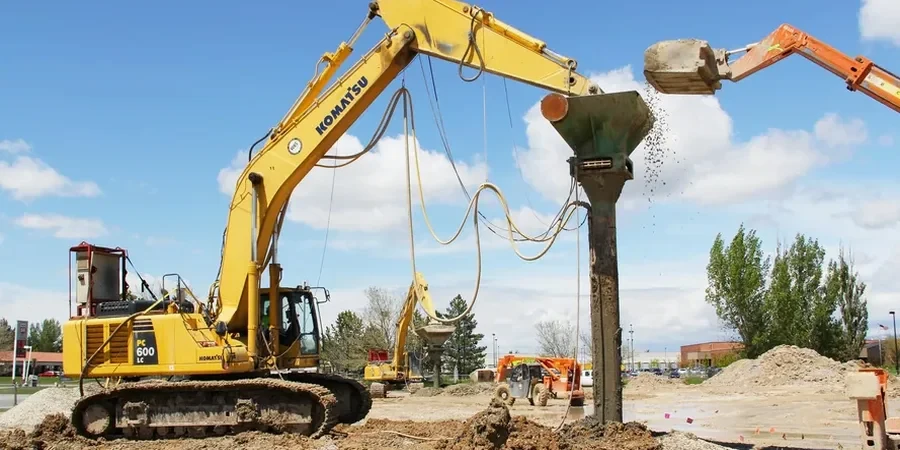
Galway’s ground conditions keep even the most seasoned builders on their toes. The city sits on a complex mix of glacial deposits, with pockets of loose silty sand layered over limestone bedrock that can hide karst cavities. When you combine that with an average annual rainfall of about 1,200 mm and a water table that sits stubbornly close to the surface in areas like Oranmore and Knocknacarra, you get a recipe for differential settlement that standard compaction simply can’t fix. That’s where vibrocompaction design becomes the difference between a foundation that settles gradually over five years and one that stays put. Our approach maps the stratigraphy first, then builds a densification grid tailored to the specific grain-size distribution of your site—because Galway till is never uniform. We often pair this with a test pits investigation to verify the upper strata before committing to probe spacing, making sure no surprises lurk beneath the topsoil.
Densifying loose glacial deposits under Galway’s high water table demands design precision, not just equipment power.
Process and scope
A mistake we see repeatedly across Galway projects is treating vibrocompaction as a one-size-fits-all process—just punch probes into the ground and hope for the best. It doesn’t work that way west of the Corrib. The granular matrix here often contains lenses of silt and organic material that can clog the stone column feed or create pore pressure buildup during vibration if not properly accounted for. A proper design phase analyzes the fines content, relative density targets, and the energy input required per probe point. We specify probe spacing, penetration depth, vibration frequency, and hold times based on CPT correlations specific to glacial-fluvial deposits. The goal is reaching a relative density above 70% in the critical zone beneath footings and slabs, reducing the risk of post-construction settlement to within tolerable limits for the structure type. We’ve seen projects in the Ballybrit area where skipping this design stage led to re-compaction costs that tripled the original ground improvement budget—money that could have been allocated elsewhere.
Common questions
How much does vibrocompaction design cost for a typical Galway residential site?
For a single dwelling or small commercial plot in Galway, vibrocompaction design fees generally fall between €1,220 and €4,060, depending on site area, depth of treatment required, and the number of pre- and post-treatment verification tests specified. Larger sites with complex stratigraphy or karst screening requirements sit at the upper end of that range. We carry out a fixed-price proposal after reviewing your site investigation data.
What depth can vibrocompaction reach in Galway’s glacial soils?
In the glacial till and fluvial sand deposits typical of Galway, effective densification depths range from 4 to 12 meters below ground level. The actual achievable depth depends on the fines content and the presence of cobbles or boulders within the till matrix. Pre-design CPT soundings help us determine the maximum practical depth for your specific site before mobilization.
Do I need a karst survey before vibrocompaction in Galway?
Not always, but we strongly recommend it for sites east of the city toward Lough Corrib, where the GSI karst database shows higher cavity density. A resistivity survey or seismic refraction line adds a few days to the investigation phase and costs a fraction of what you would spend repairing a collapse triggered during compaction. For sites on proven competent till with no karst indicators, the risk is low enough to proceed without it.
How long does the design and verification process take from start to finish?
A typical vibrocompaction design package for a Galway project takes about two to three weeks for the investigation and design phase, followed by the compaction execution which varies by site size. Post-treatment verification testing usually happens 7 to 14 days after compaction to allow pore pressures to dissipate. The full cycle from investigation to signed-off verification report averages four to six weeks for most sites under 1,000 square meters.