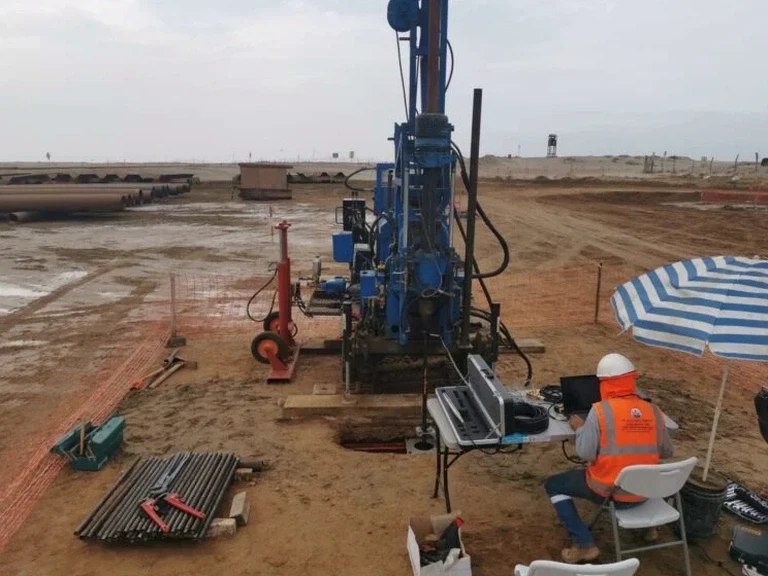
Beneath Galway's streets, the transition from limestone bedrock to the soft alluvial clays of the River Corrib creates some of the most variable ground conditions in Ireland. The city sits at 53.2744°N on the edge of the Burren karst region, where glacial till overlies fractured Carboniferous limestone. A single borehole can miss what a continuous CPT profile reveals. The cone penetration test pushes an instrumented cone into the ground at a steady 20 mm/s, recording tip resistance, sleeve friction, and pore pressure simultaneously. For sites along the N6 corridor or near Galway Bay's estuarine deposits, these readings map the boundary between competent drift and compressible clay with a precision that intermittent sampling cannot match. The data feeds directly into bearing capacity calculations and settlement predictions, cutting weeks off the ground investigation phase when the programme is planned around what the stratigraphy actually demands. On larger schemes, the plate load test provides a complementary direct stiffness measurement once the CPT has identified the target depth.
A CPT profile shows what the ground is doing every centimetre – not just what was retrieved from a few disturbed samples.
Common questions
How deep can a CPT go in Galway's glacial till?
Penetration depth depends on the till density and the rig's reaction force. A 100 kN cone typically reaches 15–25 m in normally consolidated silts and clays, but in the dense boulder clays common around Galway city, refusal often occurs between 8 and 15 m when the cone encounters a high-strength layer or a boulder. A 200 kN system can push deeper in suitable conditions. The continuous log shows exactly where refusal happens and at what resistance, which is useful information in itself for identifying bearing strata.
What is the typical cost of a CPT test in Galway?
CPT testing in Galway generally ranges from €160 to €240 per test for a standard piezocone profile with dissipation tests, depending on depth, access conditions, and whether seismic or additional pore pressure modules are required. The final cost reflects mobilisation, the number of test locations, and data reporting. A site-specific quote is always provided after reviewing the ground investigation brief.
Can CPT detect karst features in the limestone under Galway?
CPT does not image voids directly, but it is very effective at identifying the soft clay-filled fissures (grikes) and the erratic rockhead typical of the Burren-type karst that extends into Galway. When the cone encounters a rapid drop in tip resistance after a refusal-like spike, it often indicates a clay-filled solution feature between limestone pinnacles. Combining CPT data with a resistivity survey or seismic refraction improves the karst interpretation significantly.
How does CPT compare with SPT drilling for Galway sites?
CPT provides a continuous resistance profile measured every 10 mm, while SPT drilling recovers an N-value every 1.5 m from a disturbed sample. For soft clays and silts – which are widespread along the Corrib estuary and Galway Bay – CPT gives far better resolution of layering and identifies thin drainage paths that SPT intervals miss. SPT remains necessary where samples are needed for lab testing, but the two methods are often combined: CPT defines the stratigraphy and SPT targets the depths where Atterberg limits or triaxial testing are required.