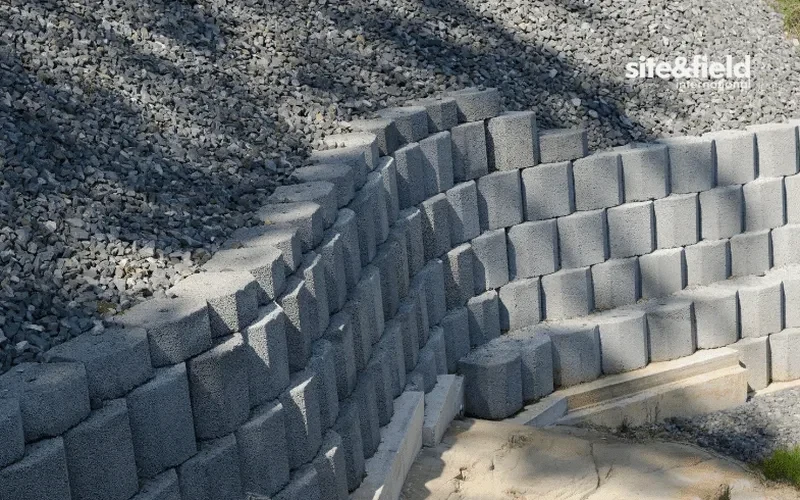
Galway's ground rarely cooperates. You dig down a metre and hit dense glacial boulder clay. Or you find shattered limestone with cavities you could park a car in. Many contractors here have learned the hard way that a standard precast block wall won't cut it. We design gravity, cantilever, and embedded walls that work with these conditions, not against them. Before finalizing a wall type, we often verify the soil profile with a test pit investigation to confirm the depth to bedrock and assess the boulder content. The Corrib's influence means groundwater is never far away, and that hydrostatic pressure behind a wall can cause failure months after construction if not properly drained. Our designs include detailed drainage specifications and filter material gradings specific to Galway's silty sands.
A retaining wall in Galway is primarily a drainage problem. Solve the water, and the structural design becomes straightforward.
Local ground factors
Karstification is the wildcard in Galway's geology. The Burren-type limestone extends eastwards, and the city itself sits on the Galway Granite batholith margin. The contact zone between granite and limestone creates unpredictable ground. You can have solid granite at 2 m depth in one spot, and 20 m of soft infill in a cavity 5 m away. A retaining wall founded partially on rock and partially on infill will expertise differential settlement. The wall cracks. The joint opens. Water enters and accelerates failure. We address this by specifying a continuous granular founding pad or, where the risk is high, replacing the gravity wall with an embedded pile wall. The high rainfall—Galway gets over 1,100 mm annually—means we design all drainage systems for a 1-in-100-year storm event with climate change allowance.
Common questions
What ground investigation is needed before designing a retaining wall in Galway?
At minimum, we need a borehole or trial pit extending to at least twice the retained height below the foundation level. For a 3 m wall, that means a 6 m deep borehole. The investigation must log the glacial till consistency, record groundwater strike, and include laboratory classification testing. In karst-prone areas east of the city, we also specify rotary coring or geophysics to rule out cavities beneath the foundation.
What is the typical cost range for a retaining wall design in Galway?
The structural-geotechnical design package typically ranges from €900 for a simple gravity wall under 1.5 m to €3,940 for a fully detailed cantilever or embedded wall with drainage design and construction stage support. The final fee depends on the wall height, ground complexity, and whether we need to coordinate with the local authority for road proximity approvals.
How do you handle high groundwater in Galway wall designs?
We design the drainage system as a critical structural element, not an afterthought. This means a granular drainage blanket behind the wall, a perforated collector pipe at the base wrapped in geotextile, and weep holes at 1.5 m spacing. We calculate the flow rate using Darcy's law based on the site's permeability test results. For walls below the water table, we include hydrostatic pressure as a permanent action in the DA1-1 load case and verify the structural capacity under full saturation.