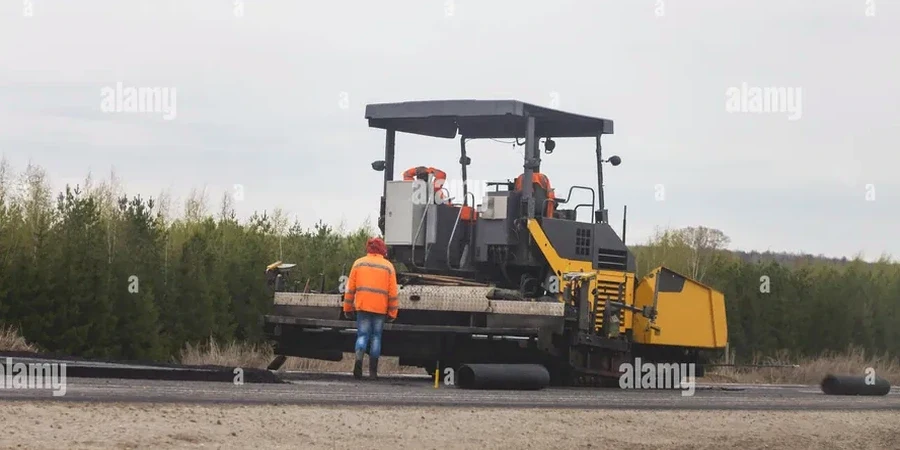
A common mistake in Galway is treating the road subgrade as an afterthought. Contractors pour money into asphalt layers and then wonder why rutting appears after one winter. The subgrade is the pavement's foundation. In Galway, that subgrade is often glacial till, limestone bedrock, or worse — soft peat pockets near the River Corrib floodplain. The city's 2023 rainfall exceeded 1,200 mm, and every millimetre of water that seeps into an unsaturated base course weakens it. A pavement design that ignores seasonal saturation is a pavement destined for premature failure. We correlate field CBR values with laboratory resilient modulus tests to establish a modulus that accounts for Galway's wet-dry cycles. The output is a pavement cross-section with layer thicknesses, material specifications, and drainage provisions that actually survive the west of Ireland climate.
A pavement's lifespan is decided in the first 300 millimetres below the formation level — the part nobody sees until it fails.
Reference standards
IS EN 1997-2:2007 (Eurocode 7 – Ground investigation for pavement design), TII CC-SPW-01200 – Pavement and Foundation Design Standards, BS 1377-4:1990 – Soils for civil engineering purposes (compaction tests), IS EN 13286-2:2010 – Unbound and hydraulically bound mixtures, NRA HD 26/06 – Pavement Design (legacy, still referenced in local authority specs)
Common questions
What does a flexible pavement design package cost for a single residential road in Galway?
For a typical 100-metre residential access road, the investigation and design package ranges from €1,320 to €4,100. The spread depends on the number of boreholes or DCP test points required and whether we need to include FWD testing on an existing pavement.
How does Galway's rainfall affect the pavement design parameters?
High annual rainfall — over 1,200 mm in Galway — saturates the subgrade and reduces its effective stiffness. Our design process accounts for this by applying a drainage coefficient that reflects the site's specific groundwater level and the permeability of the capping layer. We always run soaked CBR tests because the unsoaked value is irrelevant for long-term performance here.
Which Irish standard governs flexible pavement foundation design?
Transport Infrastructure Ireland publishes CC-SPW-01200, which sets out the analytical and empirical methods for pavement and foundation design in Ireland. We also reference IS EN 1997-2 for ground investigation requirements and BS 1377 for laboratory compaction testing. Local authority specifications in Galway often supplement these with NRA legacy documents.
Can you design a pavement overlay on an existing road without coring?
We can, but we do not recommend it. A falling weight deflectometer survey provides the layer stiffness data, but without at least one core to verify asphalt thickness and condition, the back-calculation has an unquantified error margin. Our standard scope includes a minimum of three cores per 200 metres of carriageway for overlay design.