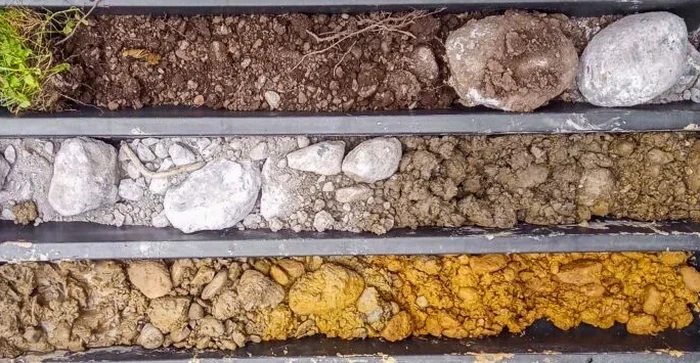
Galway’s ground conditions shift fast — from the limestone bedrock of the city centre to the glacial tills and soft alluvial clays along the Corrib. Rainwater percolates differently across these transitions, and what holds firm in Terryland may not behave the same way in Knocknacarra. Opening an exploratory test pit gives you a direct look at the strata that boreholes sometimes miss. We excavate to depths of 3.5–4.0 m, log the sequence in real time, and pull undisturbed samples for laboratory classification. When the water table sits high after a wet winter, we adjust the benching and shoring on the spot because we have worked in Galway’s subsoil long enough to know that the ground west of the river tells a different story than the ground east of it. For sites where the surface hints at buried operations or historical fill, we often combine the pit with an SPT drilling campaign to correlate resistance data with the visual log at depth.
A test pit in Galway’s glacial till gives you one thing no remote geophysics can: a hand-held sample of the exact material your footing will sit on.
Reference standards
BS 5930:2015 + A2:2020 – Code of practice for ground investigations, S.I. No. 504 of 2006 – Safety, Health and Welfare at Work (Construction) Regulations, IS EN 1997-2:2007 (Eurocode 7 – Part 2: Ground investigation and testing, Irish National Annex), HSA Code of Practice for Safety in Excavations (current edition)
Common questions
How much does an exploratory test pit cost in Galway?
A single pit with logging, sampling, and backfill typically runs between €390 and €720, depending on depth, access width, and whether we need to bring in a small tracked machine for a garden or rear extension.
Do you need a road opening licence to dig a test pit on a Galway city footpath?
Yes, any excavation in the public footpath or carriageway requires a licence from Galway City Council under Section 13 of the Roads Act 1993. We handle the application and compile the method statement and traffic management plan for you.
How long does a test pit stay open before it must be backfilled?
We keep the pit open only for the time needed to log, photograph, and sample — usually two to three hours. If the investigation requires soakage testing, the pit may stay open for up to 24 hours under controlled, barriered conditions in line with HSA excavation safety rules.
Can you excavate a test pit inside an existing building in Galway?
In some cases yes, using a mini excavator with a retractable undercarriage that fits through a standard doorway. We assess floor slab thickness, headroom, and ventilation first, and the structural engineer must clear the excavation depth relative to adjacent footings.