← Home · Underground Excavations

Geotechnical analysis for soft soil tunnels in Galway

Together, we solve the challenges of tomorrow.

LEARN MORE →

In Galway we often see projects that start with a solid design and then hit ground conditions nobody expected. The city sits on a complex mix of glacial till, alluvial silts, and pockets of limestone bedrock shaped by the Corrib River system. Tunneling here isn't just about cutting through material; it's about understanding how the soil will deform before you even break ground. The soft compressible clays found east of the city near Oranmore behave completely differently than the stiffer boulder clays west of Barna. We run the lab work that makes those distinctions clear. A grain-size analysis early on can reveal whether you're dealing with a silty matrix that will squeeze under load or a granular lens that drains fast. Our team has dealt with core samples from enough Galway boreholes to know that you need both index testing and advanced triaxial work to really characterize these deposits.

Galway's glacial clays can lose half their undrained shear strength just from being sampled, handled, and extruded. That sensitivity drives every test protocol we follow.

Process and scope

There's a stark contrast between tunneling near the Claddagh Basin, where the ground is saturated and loose, and moving into the more elevated terrain around Castlegar where the glacial deposits are denser. Near the river and bay, the water table sits high and the silty clays lose strength fast when disturbed. We've processed samples from those areas that literally liquefied during handling. Further inland the challenge shifts to mixed-face conditions: soft clay over limestone pinnacles. For those jobs we combine Atterberg limits to define the clay behavior with unconfined compression tests on rock cores. The grain size distribution tells us if the clay fraction is high enough to cause clogging on a TBM cutterhead. Standard classification tests under I.S. EN ISO 17892 give us the basic parameters, but we always recommend consolidated-undrained triaxial tests when the alignment crosses under the city center. Galway's urban geology demands that level of precision.
Geotechnical analysis for soft soil tunnels in Galway
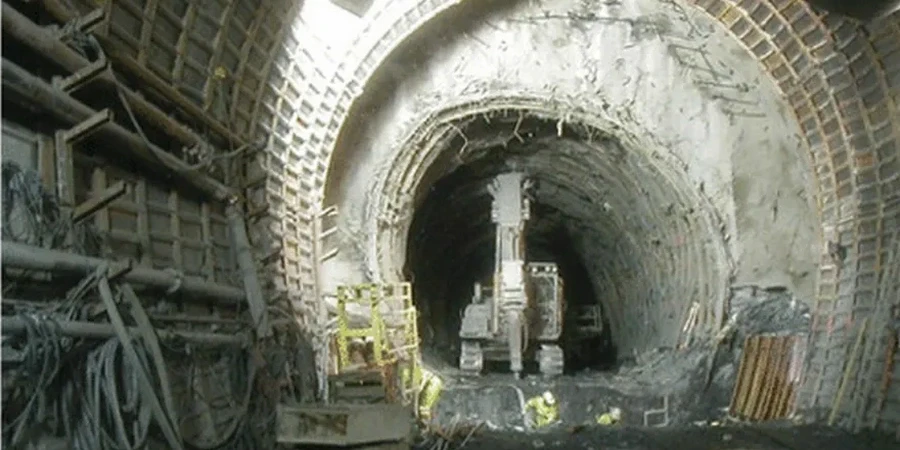
Technical reference image — Galway

Local ground factors

Galway's expansion since the 1990s pushed development onto marginal land east of the city, where the alluvial corridors mask deeper buried valleys. We've seen borehole logs from projects near the Doughiska area where 12 meters of soft organic silt lay hidden beneath a thin crust of desiccated clay. Tunnel a little too close to that interface without proper analysis and the face collapses before you can install support. The biggest risk isn't just low strength; it's the time-dependent behavior. These silts creep. A tunnel crown that stands stable for three days can sag four centimeters on day five. That's why our lab runs incremental oedometer tests to quantify secondary compression. We also check for soluble sulfates in the ground because Galway's limestone-derived soils can attack concrete linings over time. Ignoring those chemical factors turns a short-term geotechnical success into a long-term durability failure. Every sample we test tells part of the story that keeps a tunnel safe over its full design life.

Need a geotechnical assessment?

Reply within 24h.

Email: contact@geotechnical-engineering.co

Technical data

ParameterTypical value
Undrained shear strength (cu)15 to 60 kPa (soft to firm glacial clays)
Sensitivity (St)4 to 15 (medium to highly sensitive silts)
Liquidity Index (IL)0.8 to 2.2 (soft, near-liquid state)
Coefficient of consolidation (cv)0.5 to 3.0 m²/year (slow drainage)
Unconfined Compressive Strength (rock)25 to 80 MPa (karstic limestone)
Soil friction angle (φ')24° to 32° (effective stress, normally consolidated)
Clay fraction (<2μm)25% to 65% (high clogging potential)

Complementary services

01

Advanced triaxial testing for soft clays

Consolidated-undrained (CU) and consolidated-drained (CD) triaxial tests to define effective stress strength parameters. We use local back-pressure saturation techniques for Galway's silty clays to get reliable pore pressure response.

02

One-dimensional consolidation and creep

Incremental oedometer tests (IL and CRS) to determine compression index, preconsolidation pressure, and the coefficient of secondary compression. Critical for predicting long-term settlement over a tunnel crown.

03

Chemical aggressivity screening

pH, sulfate, and chloride testing on soil and groundwater samples per I.S. EN 206. Essential for specifying the right concrete mix and protective measures for tunnel linings in Galway's limestone-derived ground.

Reference standards

I.S. EN 1997-2:2007 (Eurocode 7 — Ground investigation and testing), I.S. EN ISO 17892 (Geotechnical laboratory testing series), I.S. EN ISO 14688 (Identification and classification of soil), NRA (now TII) Specification for Ground Investigation, BS 5930:2015 (Code of practice for ground investigations)

Frequently asked questions

What lab tests are mandatory before tunneling through soft ground in Galway?

At minimum you need classification tests (moisture content, Atterberg limits, particle size distribution) and strength tests (triaxial CU or unconfined compression). For Galway's sensitive silts we strongly add oedometer consolidation tests. Chemical testing for sulfates is also mandatory per the National Annex to I.S. EN 206 for concrete durability.

How much does a full geotechnical testing program for a tunnel project cost?

A comprehensive laboratory program for a soft-ground tunnel alignment in Galway typically ranges from €4,030 to €13,850, depending on the number of boreholes, depth of sampling, and the mix of classification versus advanced triaxial tests required.

How do you handle disturbed samples from Galway's sensitive clays?

We minimize extrusion disturbance by using thin-walled tube samples and trimming them carefully in a humidity-controlled lab. For highly sensitive silts we sometimes test at in-situ moisture content without full remolding. The key is getting the sample into the triaxial cell fast and applying a back-pressure that matches the field pore pressure.

What's the difference between testing for a TBM tunnel versus a sequential excavation in soft ground?

For TBM jobs we focus on abrasivity, clogging potential (Atterberg limits and clay fraction), and face pressure calculations. For sequential excavation (SEM/NATM) we need more detailed stress-strain data from triaxial tests to model ground convergence around the heading. The testing program adapts to the construction method.
Location and service area

We serve projects in Galway and surrounding areas.

View larger map