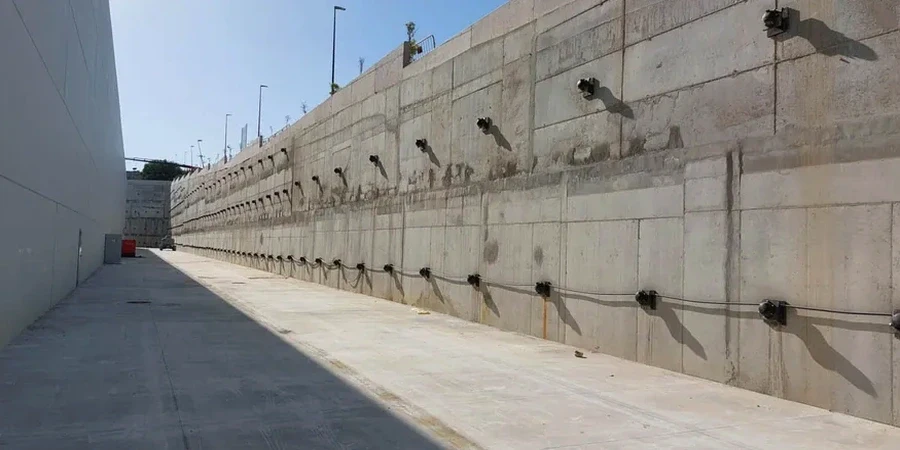
Galway's ground profile rarely offers a straightforward day's work for a designer: the city spreads over Carboniferous limestone blanketed by glacial tills deposited during the last ice age, and anyone who has excavated near the River Corrib or out toward Barna knows that groundwater is never far below the surface. This combination of stiff, sometimes boulder-laden drift over fissured bedrock demands a restraint approach that goes well beyond a textbook detail. The anchor designs we prepare here — whether active tendons stressed against a waling beam or passive grouted bars mobilizing resistance through a slope cut — must account for variable bond lengths, corrosion protection suited to Galway's damp, marine-influenced atmosphere, and the real possibility that a borehole hits a karst void halfway through its bond zone. Before committing to a retention scheme, many contractors in the west of Ireland first run a CPT test to map the drift-to-bedrock transition continuously, which helps us position fixed anchors where the grout column will actually hold.
An anchor design that ignores Galway's karst fissures and tidal groundwater is not a design — it is a future excavation failure waiting to happen.
Process and scope
On sites across Galway city and the eastern suburbs, we repeatedly see that the biggest design risk is not the steel capacity but the grout-ground interface where the limestone is fractured. A passive anchor drilled into apparently sound rock can still lose efficiency if the fissure network channels grout away from the bar, so our standard procedure includes pre-grouting the bond length with a stable, low-bleed mix specified under IS EN 14490:2010, followed by a proof load test on the first production anchors. For active anchors in temporary excavations, we typically work with multi-strand systems delivering working loads between 300 kN and 1,200 kN, while passive rock bolts in cut slopes along the N6 corridor more commonly sit in the 100 kN to 350 kN range: the lower end suits weathered limestone benches, the upper end tackles competent grey limestone where a wedge failure would be catastrophic. Galway's tide-influenced water table also forces us to specify double-corrosion-protection (DCP) for any permanent anchor installed within 200 m of the estuary, because the chloride exposure class climbs quickly once you cross the line from freshwater Corrib to the salt wedge near the Claddagh. This practical, layered approach to durability is what keeps anchors performing long after the scaffold has been struck.
Common questions
How much does an anchor design package typically cost for a Galway excavation project?
Design fees for anchor systems in the Galway area generally fall between €820 and €3,830, depending on the number of anchor levels, whether the anchors are active or passive, and the extent of testing and supervision required. A straightforward single-level passive anchor scheme with six to eight bars will sit at the lower end; a multi-level active anchor design for a deep excavation with pre-grouting against karst, detailed waling calculations, and on-site stressing supervision will reach the upper range. All scopes include the design report, construction drawings, and the acceptance test specification.
How do you determine the bond length in Galway's variable limestone?
The bond length is never taken from a table value alone. We require rotary-cored boreholes with rock quality designation (RQD) and fracture spacing logged per IS EN ISO 14689-1. Where the limestone is fractured — common in the middle to upper units around Galway — we increase the bond length and specify pre-grouting with a stable cement mix to fill fissures before the anchor grout is placed. A pre-production suitability test on the first anchor confirms that the selected bond length delivers the required load with an acceptable creep rate under the sustained test load defined in IS EN 14490.
Can passive anchors be used instead of active anchors to save cost on a temporary excavation?
Sometimes, but it depends entirely on the deformation tolerance of the excavation face. Passive anchors only mobilise resistance after some movement occurs, so if the retained face is a public road or an adjacent building, that movement may be unacceptable. In Galway's dense till, a stiff active anchor system that locks off at 80–100% of the working load gives immediate restraint with minimal deflection, which usually pays for itself by avoiding third-party damage claims. We assess the trade-off case by case using the ground stiffness profile and the serviceability limit state criteria.