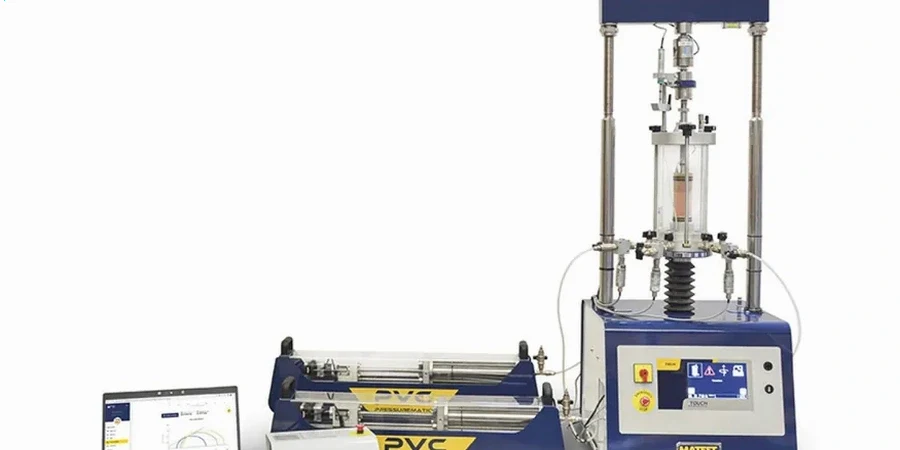
A multi-story residential development near the Docks in Galway recently faced a critical design challenge: the underlying glacial till, deposited over 15,000 years ago during the last ice retreat, exhibited significant variability in its undrained shear strength. The structural engineer, working to Eurocode 7 specifications, couldn't rely on generic correlations from SPT data alone. The project required a precise definition of the effective stress parameters (c' and φ') to model the foundation's long-term settlement and bearing capacity. This is where the triaxial test becomes indispensable, moving beyond index properties to replicate the actual in-situ stress state. By consolidating specimens to the estimated overburden pressure and then shearing them under controlled drainage conditions, the laboratory provided the critical failure envelope.
For projects on the compressible alluvial deposits along the River Corrib, integrating the triaxial test with a detailed grain size analysis ensures the soil classification aligns perfectly with the measured mechanical behavior, a step often overlooked but essential for solid numerical modeling in PLAXIS or similar finite element software.
The triaxial test provides the critical stress path and failure envelope—essential data that no SPT blow count can ever approximate for Galway's complex glacial deposits.
Process and scope
The application of the triaxial test in Galway is governed by I.S. EN ISO 17892-8:2018 (Unconsolidated Undrained) and I.S. EN ISO 17892-9 (Consolidated Drained), which detail the procedures for specimen saturation, consolidation, and shearing stages. Given Galway's average annual rainfall of approximately 1,150 mm and the prevalence of high groundwater tables in areas like Salthill and Oranmore, the Consolidated Undrained (CU) test with pore pressure measurement is particularly relevant—it isolates the effective stress response from the generated excess pore pressures, a condition that often governs stability during rapid construction loading. The laboratory is equipped with automated Bishop & Wesley-type cells capable of applying confining pressures up to 2 MPa, using precision digital volume change indicators and pressure transducers calibrated to ISO 17025 standards.
When a site investigation near Lough Atalia reveals sensitive, low-plasticity clay, coupling the triaxial test with the
Atterberg limits determination provides a complete picture of the soil's consistency and its potential for strain-softening under shear, a phenomenon well-documented in western Irish glacial lacustrine deposits.
Local ground factors
Galway's urban expansion, from the medieval core outwards onto reclaimed marshland and drumlin flanks, means many current construction sites straddle geotechnically contrasting units. A development on the Headford Road might encounter a stiff, overconsolidated boulder clay adjacent to a soft, normally consolidated peat pocket within the same building footprint. Designing footings or a mat foundation without defining the shear strength of each distinct layer through the triaxial test introduces a real threat of differential settlement that could compromise the superstructure within the first few years.
The work of Bishop and Bjerrum on undrained shear strength, later refined by Ladd's SHANSEP procedure, underpins the understanding that ignoring the geological history of Galway's tills—once loaded by over a kilometer of ice—can lead to a 40% underestimation of preconsolidation pressure. A site-specific failure envelope from a CU triaxial test anchors the design in physical reality, preventing both the over-reliance on conservative empirical formulas and the catastrophic under-design that can result from a single borehole log taken out of geological context.
Common questions
What is the typical cost range for a triaxial test program on a Galway site investigation project?
A single triaxial test (CU or UU) typically falls between €1,590 and €2,780, depending on the required confining pressure stages, the specimen diameter, and whether advanced stress path control is needed. A project-specific program with three or more tests is priced based on the total number of specimens and the complexity of the loading sequence.
How do we select between a UU and a CU triaxial test for the boulder clays common around Galway?
For short-term stability during construction, a UU test provides the undrained shear strength (Su) directly. However, for long-term effective stress analysis—critical for the heavily overconsolidated boulder clays—a CU test with pore pressure measurement is required to determine the effective friction angle (φ') and cohesion intercept (c'). The CU test allows the engineer to model how the soil will behave once the excess pore pressures from glacial loading have fully dissipated over the design life of the structure.
What sample quality is required for a valid triaxial test according to Irish standards?
The minimum requirement is a Category A sample (Class 1 to I.S. EN ISO 22475-1), typically obtained from a thin-walled Shelby tube pushed hydraulically in a carefully cleaned borehole. Disturbed samples or those with visible cracks from gas expansion cannot be used, as they will yield artificially low strength and stiffness parameters. The laboratory inspects every specimen for fissuring and desiccation prior to mounting it in the triaxial cell.
Can the triaxial test provide the stiffness parameters needed for a settlement analysis under a raft foundation?
Yes, a consolidated drained (CD) test with local strain instrumentation on the specimen can measure the Young's modulus (E') and Poisson's ratio at very small strain levels (0.001% to 1%). This data is directly input into the Hardening Soil Small-Strain (HSS) constitutive model used in advanced finite element analyses, providing a significantly more accurate settlement prediction than using generic correlation tables for Galway's stiff glacial tills.