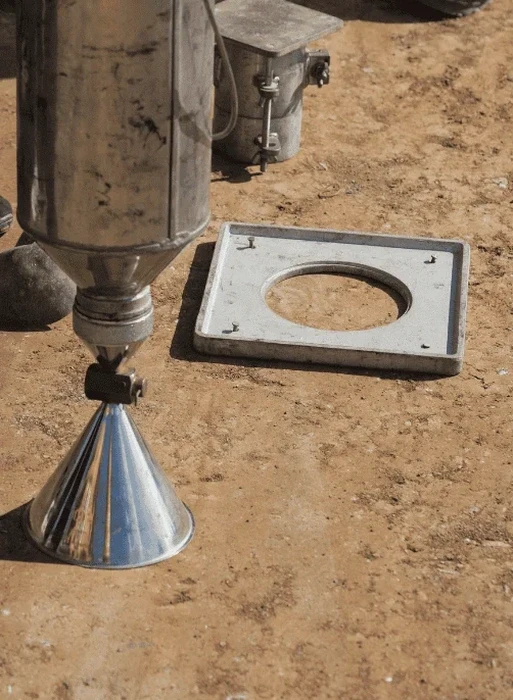
Galway's underlying geology shifts dramatically within a few kilometres, from the Carboniferous limestone bedrock of the Burren Lowlands to the granite of the Galway Batholith, but what contractors actually deal with is the blanket of glacial till and alluvial deposits left by the Corrib and its tributaries. The city's expansion into areas like Doughiska and Knocknacarra has exposed highly variable ground conditions where compaction control is not just a specification checkbox, it's the difference between a stable platform and one that settles differentially after the first wet winter. In our expertise running test pits across these new developments, we often see a frustrating contrast: fill that looks dense at the surface but loses 15-20% of its target dry density just half a metre down because the underlying till was too moist during placement. The sand cone method remains the most reliable field check for these situations, giving you a direct measurement of in-place density rather than an indirect reading from a nuclear gauge, which is particularly useful when you're dealing with the variable cobble content typical of Galway's glacial deposits.
A well-executed sand cone test on glacial till gives you a density number that correlates directly with plate load stiffness, without the calibration drift that plagues nuclear gauges in wet ground.
Local ground factors
The kit itself is deceptively simple: a calibrated sand cone bottle, a base plate with a tapered centre hole, and a bag of graded sand that flows freely when the valve is opened. What makes or breaks the test in Galway is the technician's ability to excavate a clean, vertical-sided hole in material that often contains rounded limestone cobbles embedded in a sandy silt matrix. If the hole walls collapse or a cobble is dislodged, the sand volume measurement becomes meaningless, and you'll report a density that is 5-8% lower than the true value, potentially causing a contractor to reject perfectly compliant fill. On road widening projects along the N6 corridor and in commercial developments near the Galway Clinic, we also deal with the complication of testing through a geotextile separator layer where the fabric can interfere with sand flow into the hole. The mitigation is straightforward but requires discipline: always dig the test hole with a small spoon and brush rather than a spade, and when you hit a cobble, carefully undercut around it rather than prying it out. A single poorly executed density test on a critical lift can trigger a chain of re-testing that delays the earthworks programme by a full day. The sand cone method also gives you the material excavated from the hole for a direct moisture content determination using a portable stove or microwave, which is essential in Galway because the actual moisture content of the compacted fill often deviates from the laboratory optimum by a margin that matters for long-term volume stability.
Reference standards
TII Standard Specifications for Road Works (Series 600: Earthworks), I.S. EN 13286-2:2010 (Unbound and hydraulically bound mixtures — Test methods for dry density and water content), BS 1377-9:1990 (In-situ density tests — Sand replacement method, still referenced in Irish practice), I.S. EN 1997-2:2007 (Eurocode 7 — Ground investigation and testing, with Irish National Annex)
Common questions
How much does a field density test using the sand cone method cost in Galway?
For a single test visit within Galway city or the immediate suburbs, you would typically see a cost between €90 and €140 per test point, depending on the number of points requested and the travel distance. A half-day programme with 4-6 test locations on a single site brings the per-test cost toward the lower end of that range. The price includes the calibrated sand, the density plate, field moisture determination, and the stamped report with relative compaction calculation.
When should I use the sand cone method instead of a nuclear density gauge?
The sand cone method is the preferred choice when you are working with wet or highly variable soils where the nuclear gauge's calibration can drift, or when the material contains a significant fraction of coarse particles that alter the gauge's response. It is also the definitive method for referee testing when there is a dispute over compaction compliance. In Galway's estuarine silts and damp glacial tills, the sand cone test eliminates the moisture-related uncertainty that affects nuclear gauge readings, giving you a direct mass-and-volume measurement that is independent of the soil's chemical composition.
How long does a sand cone density test take, and when will I receive the results?
A single test point, from setting up the plate to sealing the moisture sample, takes about 15 to 20 minutes in reasonably accessible fill. If we are running a programme of multiple points across a site, the rate is typically 3 to 4 tests per hour including movement between stations. We carry out the dry density and relative compaction results verbally to the site engineer or foreman on the spot, and the formal stamped PDF report is issued the same day by email, with the test locations referenced to a site grid or GPS coordinates.