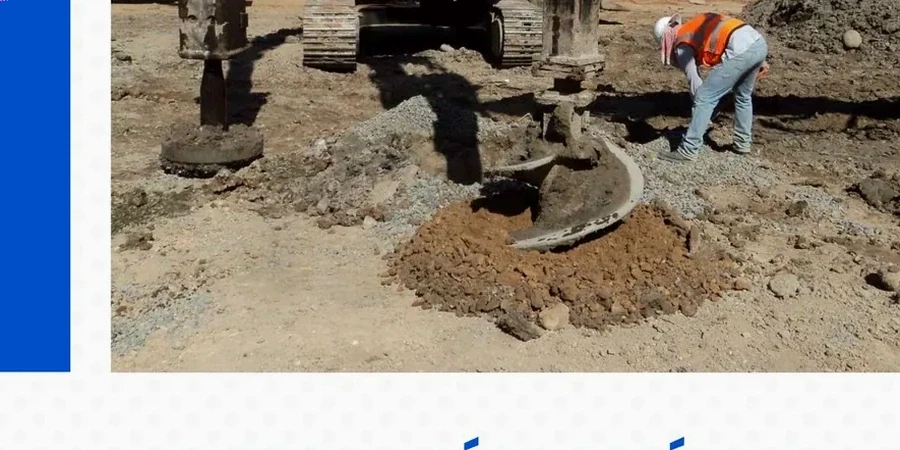
Galway sits on some of the most compressible soils in the west of Ireland, a reality that plays out in every infrastructure project from the M6 widening to the new builds east of the Corrib. With a mean elevation barely scraping 25 metres and rainfall topping 1,200 mm per annum, the city’s glacial till, alluvial silts, and interbedded peat demand more than a standard foundation approach. In our expertise, stone column design offers the only viable path when you need bearing capacity and drainage without removing metres of organic material. We’ve applied the method under warehouse slabs near Parkmore, beneath embankment approaches at Oranmore, and for flood-protection bunds where time and access ruled out deep excavation. The work always starts with a proper ground model, and we often pair the stone column layout with an in-situ permeability survey to confirm how the radial drainage will behave once the columns are in place.
A well-designed stone column grid transforms peat and soft silt into a composite mass that can carry twice the load of the untreated ground.
Local ground factors
Much of Galway’s expansion since the 1990s has pushed onto low-lying agricultural land around the Terryland and Clare rivers, ground that spent centuries accumulating soft sediments with little consolidation. When stone columns are designed without a site-specific settlement assessment, the consequences surface within the first wet season: differential movement between column-treated and untreated zones, cracked floor slabs, and stormwater drainage that ponds instead of flowing. The peat layers here are irregular in thickness, and a borehole that misses a 2-metre pocket can lead to under-design. We’ve also seen cases where an overly aggressive column spacing choked the radial drainage, trapping pore pressure rather than relieving it. The fix is always more expensive than the original investigation, which is why our team insists on at least three CPT profiles across the footprint before finalising the grid. In sensitive structures near the estuary, we integrate the design with a liquefaction screening so the ground improvement tackles both static settlement and seismic demand in one sequence.
Reference standards
Eurocode 7 – EN 1997-1:2004 (Geotechnical design general rules), Eurocode 7 – EN 1997-2:2007 (Ground investigation and testing), IS EN 1998-5:2005 (Seismic design – foundations, retaining structures), ICE Specification for Ground Treatment (current edition), TII/NRA guidance notes for embankments on soft ground
Common questions
What does stone column design cost for a typical Galway site?
For a design package that includes ground investigation interpretation, column layout calculations, and a performance specification, fees typically range between €1,460 and €4,520 depending on the site area and number of design cases. A straightforward warehouse pad with uniform ground sits at the lower end; a flood bund with variable peat depth and multiple limit states pushes toward the upper figure.
How does Eurocode 7 handle stone column design differently from older Irish practice?
Eurocode 7 requires a design-by-calculation approach with declared limit states, partial factors on actions and ground parameters, and explicit verification of both ultimate and serviceability conditions. Older practice often relied on empirical settlement charts. Under EN 1997-1:2004 we now define the design column length by the depth where composite shear strength meets the factored demand, not just by the bottom of the soft layer.
Can stone columns be installed through Galway’s peat without excavation?
Yes, that is one of the method’s main advantages here. The vibroflot displaces the peat laterally and the stone column is built from the bottom up, so there is no open excavation and no spoil to dispose of. The key is confirming the peat thickness and base conditions with CPT soundings beforehand, because very thick or gas-charged peat may require a modified installation sequence.
How do you verify stone column performance after installation?
We use a combination of post-installation CPT soundings through the column centre and between columns to measure the improvement in tip resistance and friction ratio. For settlement-sensitive projects we also run zone load tests over a group of columns, instrumented with settlement plates and piezometers to confirm the drainage path is functioning as designed.