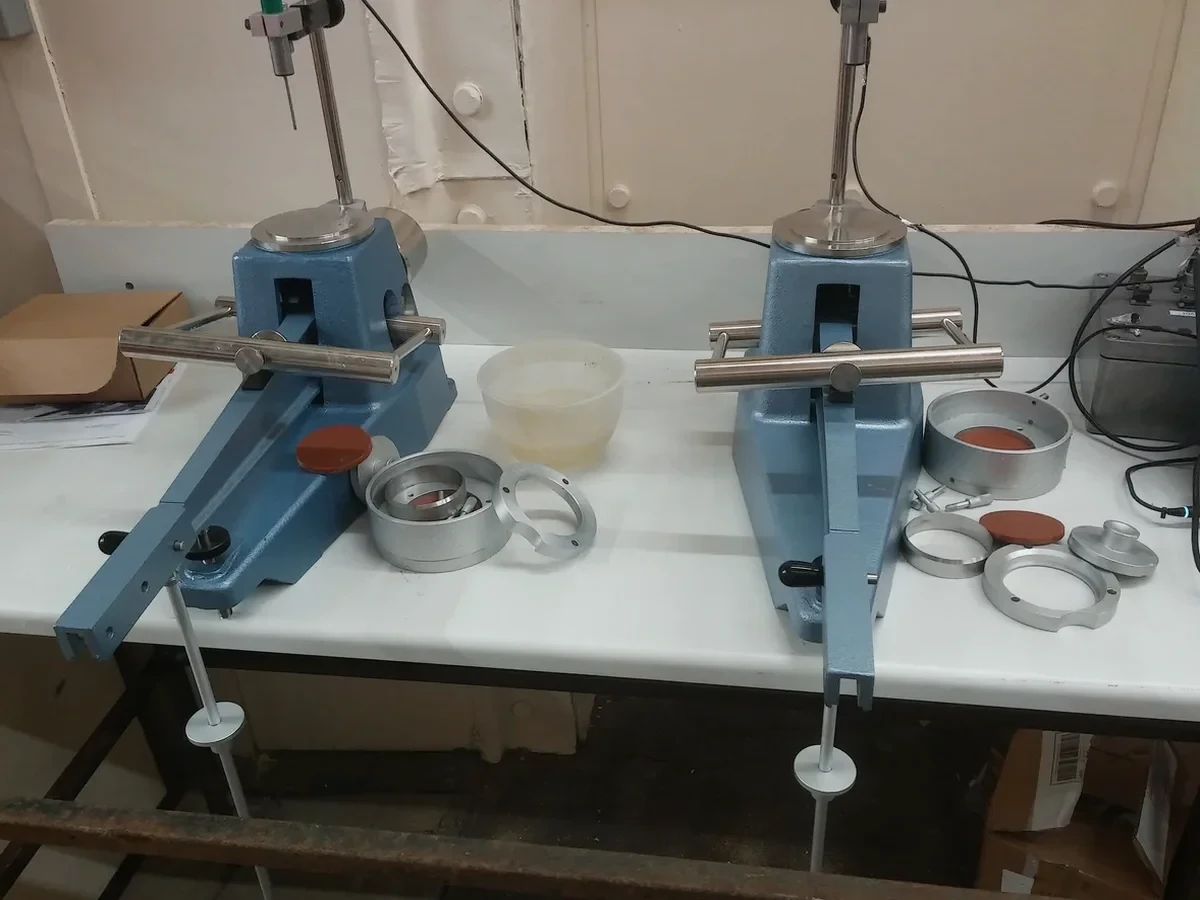
The damp climate of Galway, where Atlantic fronts deposit over 1,200 mm of rain annually across the Corrib basin, creates fine-grained soils that demand precise characterization before any construction project. The glacial till and alluvial clays found in areas like Oranmore or the river corridors of the Terryland and Clare rivers change their consistency dramatically between summer drying and winter saturation. This is where Atterberg limits testing becomes the key to understanding the behavior of local cohesive materials: it defines the moisture thresholds at which soil passes from a solid to a plastic state, and from a plastic to a liquid state. Without this data, the risk of differential settlements or loss of bearing capacity under the persistent drizzle of the west of Ireland becomes real. For projects requiring deep foundations in the softer deposits near Galway Bay, it is common to complement the classification with an SPT drilling campaign to correlate these fine soil parameters with in-situ strength profiles.
In plastic clays, a variation of just 2% in moisture content can transform a stable subgrade into a construction problem. The Atterberg limits define that exact threshold.
Local ground factors
The Casagrande cup and the glass plate are the precision tools that define the plastic behavior of a soil, but in Galway, the real risk lies in underestimating the natural variability of local drift deposits. A single borehole in an area like Knocknacarra can reveal a clean gravel overlain by a pocket of soft, high-plasticity clay that would remain invisible without detailed laboratory testing. Omitting Atterberg limits in these transitional zones can result in foundation designs based on an incorrect soil classification: a low-plasticity silt mistaken for a high-plasticity clay will generate unrealistically high bearing capacity values, leading to settlements not considered in the structural calculations. When a retaining wall is built on these materials, the swelling pressure exerted by a high-plasticity clay during the rainy season can induce lateral thrusts that exceed the design assumptions, compromising the long-term stability of the structure.
Common questions
What is the difference between liquid limit and plastic limit in a practical sense?
The liquid limit tells us when the soil begins to behave like a viscous fluid, losing all shear strength: in Galway, this is critical for clays that will be under the water table. The plastic limit indicates the moisture content at which the soil can be molded without cracking, defining the working range for compaction in earthworks on sites like the Galway Docks.
How much does an Atterberg limits test cost in Galway?
The test for determining liquid limit, plastic limit, and plasticity index on a disturbed sample falls within a range of €60 to €110, depending on the number of specimens and whether additional preparation is required to remove organic matter, common in peat-adjacent samples in the Galway area.
Why is the plasticity index so important for road construction in the west of Ireland?
A high plasticity index indicates a soil that will expertise large volume changes with moisture variation. On roads connecting Galway to Connemara, where rainfall is constant, a subgrade with PI greater than 20 can cause severe cracking in the pavement if it is not stabilized or replaced with a granular layer of appropriate thickness according to NRA specifications.
What sample quantity is needed to perform the Atterberg limits?
About 200 grams of material passing the 425 µm sieve is required. The sample must be representative of the fine fraction of the soil, so it is essential that the extraction in a test pit or SPT borehole in Galway properly preserves the natural moisture content, avoiding drying that would alter the limit values.