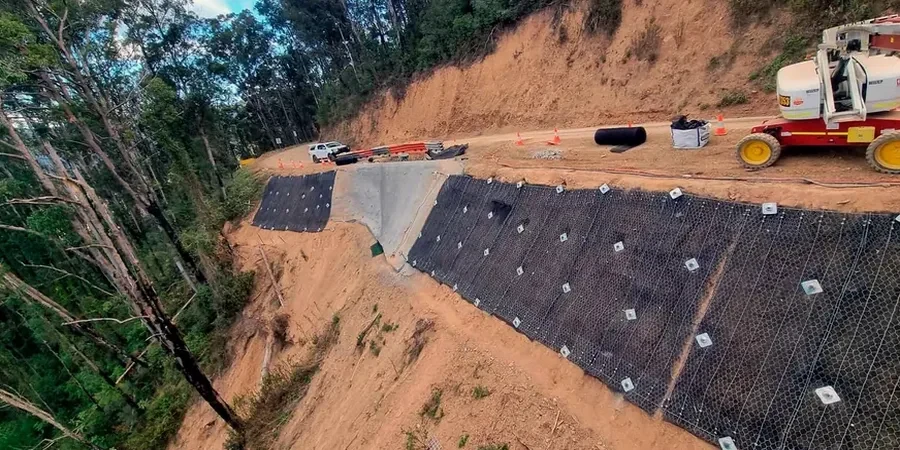
The combination of Atlantic storm fronts, saturated glacial tills and the deeply incised river valleys of the River Corrib catchment means slope stability in Galway demands more than a textbook factor of safety. Our analytical approach starts with the premise that Galway’s average annual rainfall exceeds 1,100 mm, which keeps pore-water pressures elevated for months at a time and triggers progressive softening in clay-rich drift deposits that mantle the granite bedrock. We run two-dimensional limit equilibrium models – Bishop, Spencer and Morgenstern-Price – calibrated against borehole logs and piezometer readings from the same site, because generic parameters lifted from a desk study simply cannot capture the anisotropy that develops in lodgement tills after multiple wetting-drying cycles. When the geometry exceeds 8 m in height or the consequence class sits at CC2 or above, the triaxial testing programme provides the effective-stress strength envelope that feeds directly into the stability model, and for road widening schemes along the N6 or N59 corridors a preceding seismic refraction survey often delineates the bedrock surface beneath colluvium with far less ambiguity than probe-only investigations.
A slope that stands today in Galway may reach limiting equilibrium in February after three months of continuous rainfall – analysis has to simulate that timeline, not just a single water table.
Process and scope
Galway’s expansion eastward into drumlinised terrain and westward onto peat-covered lowlands has produced a legacy of cut slopes in heterogeneous materials that behave very differently from the clean sands assumed in introductory textbooks. Our stability runs explicitly account for the presence of a weathered upper crust in the Galway Granite batholith, which can lose more than 60 % of its intact strength within the first two metres of the weathering profile. We input stratigraphic boundaries digitised from trial pit logs into Slide2 or Slope/W, assign material models that honour the pre-shear history of each unit, and then back-analyse any visible tension cracks or shallow slumps using Janbu’s simplified method to validate the pre-failure pore-pressure regime. Because the city sits astride the boundary between the granite pluton to the north and the Carboniferous limestone to the south, a single site can straddle two fundamentally different geotechnical provinces, and the stability model must reflect that transition rather than averaging properties across an artificial ‘representative’ column. The output is a deterministic factor of safety supplemented by a probability density function that shows the likelihood of falling below unity under the design groundwater scenario prescribed in the Irish National Annex to Eurocode 7.
Common questions
What is the typical cost of a slope stability analysis for a single-family dwelling site in Galway city?
For a residential site with a slope height under 5 m, the analysis typically falls between €1,230 and €1,860, assuming existing ground investigation data of reasonable quality. Where new boreholes, laboratory triaxial testing and piezometer installation are required, the combined investigation-and-analysis package ranges from €2,400 to €3,460, depending on access constraints and the number of material units that need characterisation.
Do Galway City Council or the County Council always require a slope stability report for planning applications?
Not for every application, but any development that proposes cuts or fills exceeding 2.5 m in height, or sits within a mapped landslide susceptibility zone, will almost certainly trigger a request for a stability assessment under the requirements of the County Development Plan and compliance with the Building Regulations Technical Guidance Document B. Early engagement with the area engineer saves weeks of delay.
Can you analyse a rock slope in the Galway Granite using the same methods as a soil slope?
The fundamentals are similar, but a granite-cut slope introduces discontinuity-controlled failure modes – wedge sliding, planar sliding and toppling – that require stereonet-based kinematic analysis before any limit equilibrium run. We apply the Hoek-Brown failure criterion with a Geological Strength Index calibrated from scanline surveys, and we explicitly model the weathered granite crust as a separate material because its properties degrade sharply within the first few metres.