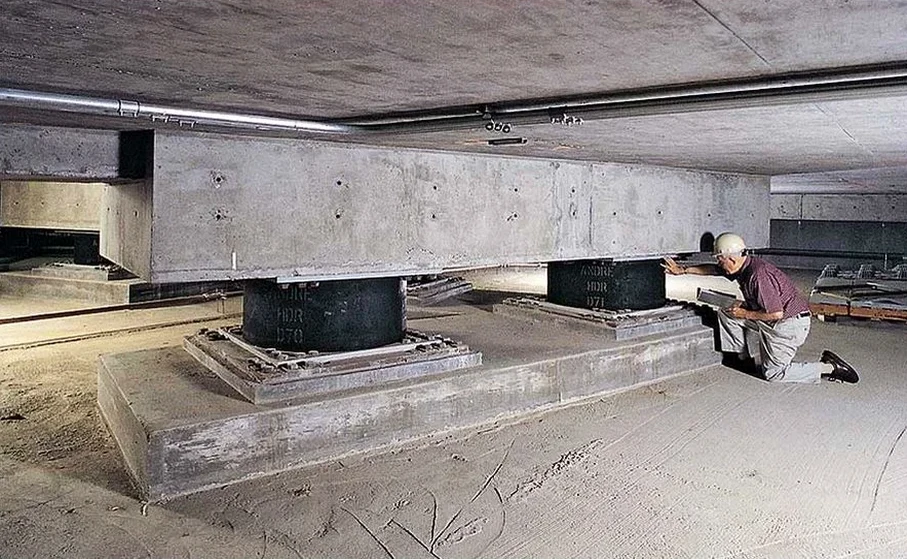
The hydraulic jack assembly sits level on the limestone bedrock, its pressure gauge calibrated to fractions of a millimetre. In Galway, base isolation design starts with understanding how the isolator—whether a high-damping rubber bearing or a friction pendulum system—will perform on the city’s variable drift geology. Galway straddles a boundary between karstified Carboniferous limestone and pockets of glacial till, and that contrast demands more than a standard specification. Our engineering team models each bearing’s force-displacement curve against site-specific ground motions, factoring in the long-period energy typical of Atlantic margin seismicity. For projects near the River Corrib or on the alluvial flats east of Lough Atalia, the stiff upper crust can mask deeper impedance contrasts. Integrating the MASW survey into the design phase clarifies the Vs30 profile, while borehole SPT data anchors the lower-bound modulus for the isolation plane. Galway’s building stock is changing—new university wings, hotel extensions, and multi-storey residential blocks all benefit from a seismic protection strategy that begins at the foundation interface.
A properly tuned base isolation system can reduce inter-storey drift by over 60% compared to a fixed-base structure—critical in Galway’s mixed-geology setting.
Process and scope
Contrast two sites separated by less than two kilometres: the granite-dominated subsoil near Salthill’s promenade versus the soft estuarine clays underlying the Docks area. In Salthill, the vibration period is short and peak ground acceleration transmits rapidly through competent rock; here the isolation system needs to shift the structure’s fundamental period decisively, often beyond 2.5 seconds, to decouple from the high-frequency content. Down by the Docks, the deeper soil column amplifies longer periods, so the same isolation strategy would be tuned differently—perhaps with a larger displacement capacity and supplementary viscous damping. Our approach to base isolation seismic design in Galway maps these micro-zonal differences before a single bearing is sized. For deep soft-ground scenarios where a basement is planned, the
diaphragm wall and excavation support sequence influences the isolation plane’s boundary conditions. We also cross-check the improved ground response when
stone columns are used beneath raft-isolation combos, ensuring the composite stiffness feeds correctly into the non-linear time-history analysis. Every Galway project gets a bespoke design basis, not a copied template, because the city’s Quaternary sediment cover changes radically within short distances.
Local ground factors
The Atlantic weather that defines Galway—frequent rain, high relative humidity, and salt-laden westerlies—also imposes a durability regime on isolation hardware that inland designers rarely face. Elastomeric bearings installed below the damp-proof course must resist ozone cracking and moisture ingress across decades, not just years. Galway’s karst landscape adds another layer: solution features in the limestone can create perched water tables or sudden stiffness contrasts that skew the ground motion input. A seismic gap that looks adequate on paper may close unexpectedly if the subsoil beneath one wing of a building settles differentially after heavy winter saturation. We address this by specifying corrosion-resistant stainless steel shim plates as standard and by modelling upper- and lower-bound soil profiles rather than a single deterministic column. For critical public facilities in Galway city, the consequence of under-designing isolation parameters is not just structural damage—it’s functional downtime when the building is needed most. The marginal cost of solid isolation detailing is modest compared with post-event retrofit, a calculation that resonates strongly with developers who have seen flood and storm impacts on the west coast.
Common questions
What does base isolation seismic design cost for a typical commercial building in Galway?
For a mid-size commercial structure in Galway, the complete base isolation design package—including geotechnical interpretation, bearing specification, non-linear time-history analysis, and construction drawings—typically ranges from €4,350 to €7,260, excluding the supply of the isolators themselves. The exact figure depends on the number of isolation units, the complexity of the soil-structure interaction model, and whether a peer review is required by the client’s insurer.
Is base isolation mandatory for new buildings in Galway?
It is not universally mandated, but Ireland’s National Annex to Eurocode 8 requires that Importance Class III and IV structures—such as hospitals, emergency response centres, and large assembly halls—be assessed for enhanced seismic protection. In Galway, where the seismic hazard is low but not negligible, base isolation often becomes the most cost-effective compliance route for high-spec institutional and healthcare projects, especially on softer ground near the city centre.
How do you verify that the isolators will perform correctly over the building’s life?
Every bearing specified passes through a prototype testing programme defined in I.S. EN 15129, which includes ageing, creep, and full-scale dynamic cycling under design displacements. For Galway projects we also specify an inspection regime: visual checks on the seal condition every five years and a full bearing re-test at year 25 or after any significant seismic event recorded by the Irish National Seismic Network.